The S Corp Trap: Why Converting Too Early Can Cost You More Than You Save
Over 5 million businesses elect S Corp status — but converting too early can cost you more than you save. Learn when the math actually works in your favor.
Written by: JT Gorski
Date of publication: 07.01.2026
Table of Contents
“Should I convert to an S Corp?” We hear it constantly, in consultations, at networking events, and from owners who heard that a friend’s accountant saved them thousands. Somewhere along the way the S Corp election picked up a reputation as the obvious smart tax move, and plenty of owners now make it without really understanding what they’re taking on.
The numbers behind that reputation are real. More than 5 million S corporations filed returns with the IRS in 2022, making it the most common corporate structure in the country. Popularity isn’t the same as fit, though. Plenty of small business owners, particularly those who convert too early, end up spending more on the structure than it ever saves them.
What follows is a look at how the savings actually work, what they cost in practice, and how to tell whether the math lands in your favor.
Key Takeaways:
- The S Corp election works — but only above the right income threshold. At $80,000 in net profit, the election can actually lose money once admin costs are counted. The savings become meaningful between $150,000 and $200,000, where distributions are large enough to generate substantial SE tax savings.
- The structure costs more than most owners expect. Payroll administration, quarterly filings, and a separate corporate tax return (Form 1120-S) typically add $3,000 or more per year in overhead — costs that eat directly into your gross tax savings.
- A higher salary helps and hurts at the same time. Taking a larger salary reduces SE tax exposure but also shrinks the income eligible for the QBI deduction under Section 199A, so the two strategies work against each other.
- The IRS requires a "reasonable salary" — and enforces it. Setting an artificially low salary to maximize distributions is a known audit trigger. Watson v. Commissioner is a clear example of how that plays out.
- Growing businesses face a phantom income problem. S Corp income flows to your personal return whether or not you take a distribution. If you're reinvesting profits, you may owe tax on money that never left the business.
- Texas owners should do the math carefully. With no state income tax and a $2.65M franchise tax threshold that most small businesses never hit, S Corp savings in Texas are almost entirely federal — making the break-even harder to reach than in high-tax states.
- Timing the election matters. Miss the March 15 deadline and the election won't take effect until the following year. Converting before your income supports it locks you into real costs without the offsetting savings.
How the Tax Savings Work
The Self-Employment Tax Problem
Run a business as a sole proprietor or single-member LLC and the IRS treats your net profit as self-employment income. That means 15.3% in SE tax on earnings up to the Social Security wage base ($184,500 in 2026), plus 2.9% on anything above it, all before regular income tax is applied.
On a profitable business that adds up fast. A business netting $100,000 owes roughly $14,130 in SE tax on its own, before federal income tax is even in the conversation.
One offset is worth keeping in mind. Schedule C and partnership owners can often deduct up to 20% of net profit through the qualified business income (QBI) deduction under Section 199A. The catch is that it doesn’t apply to everyone. For a “specified service trade or business” (consulting, law, accounting, financial services and the like), the deduction phases out once taxable income passes $201,750 for single filerrevs or $403,500 for married filing jointly in 2026. So not every owner can count on it.
The S Corp Workaround
The S Corp election divides your income in two. You pay yourself a reasonable salary as an employee of your own business, and that salary carries payroll taxes (FICA) like any W-2 income. The profit left over reaches you as a shareholder distribution, and distributions don’t carry SE tax.
The savings come from the gap between that salary and your total profit. Earn $150,000, pay yourself a $70,000 salary, and the remaining $80,000 distribution sidesteps roughly $12,240 in SE tax at the 15.3% rate, a meaningful sum.
The part that gets glossed over is the tradeoff. A higher salary costs you in payroll taxes, but it also shrinks the income eligible for the QBI deduction. Salary reduces the K-1 ordinary income flowing through to you, and QBI is figured after that. Raising your salary to capture SE savings therefore chips away at your QBI deduction at the same time, so the two work against each other.
The Costs That Get Overlooked
SE tax savings get most of the attention. The costs tend to stay quiet until you’re inside the structure and the invoices start arriving.
Payroll Setup and Ongoing Administration
Electing S Corp status obligates you to run payroll for yourself. In practice that means standing up a payroll system, filing quarterly payroll tax returns (Form 941), and issuing yourself a W-2 at year-end. Most owners hand this to a payroll service, and depending on the provider and pay frequency, that generally runs $500 to $2,000 or more a year.
The expense is only half of it. Payroll comes with deadlines and compliance obligations, and mistakes carry consequences.
Increased Tax Preparation Fees
An S Corp files its own federal return, Form 1120-S, separate from your personal return. Next to a Schedule C filing, that usually adds $800 to $2,500 or more a year to a CPA’s bill. The exact figure tracks the complexity of the business, but for most small owners it’s a noticeable jump.
State-Level Fees and Filing Requirements
This is where it pays to know your state. Texas owners in particular run into a common misconception: the Texas franchise (margin) tax already applies to both LLCs and S Corps, so converting doesn’t add a new state tax. With the 2026 No Tax Due threshold sitting at $2.65 million in gross receipts, most small businesses owe nothing on it regardless of how they’re structured.
Texas also levies no personal state income tax, which means the savings from an S Corp election here are almost entirely federal. Compare that to California or New York, where state income tax rates make the structure far more valuable, and the importance of checking your own state’s rules becomes clear.
The Break-Even Math
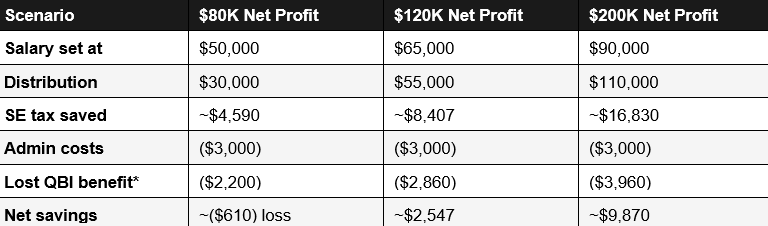
Stack those factors together and the picture gets more textured than most online advice lets on. The table below works through three income levels, each assuming $3,000 in annual admin costs and a 22% marginal federal income tax rate:
* Lost QBI benefit = 20% x salary x 22% marginal rate. Assumes full QBI eligibility.
At $80,000 in net profit, the election loses money once every cost is counted. At $120,000 it turns modestly positive. By $200,000 the case is hard to argue with.
In other words, the election isn’t a straightforward tax-savings tool at modest income. It rewards businesses earning enough to absorb the added costs.
Why Early Conversion Is the Trap
The Income Threshold Reality
Those numbers explain why the election rarely shows clear net savings below $80,000 in net profit, and why it usually turns meaningfully favorable somewhere between $150,000 and $200,000. The exact point depends on your salary level, your state, and how much of the QBI deduction you can still claim.
Which is why telling a business that nets $60,000 a year to “just elect S Corp status” is shaky advice. The savings haven’t materialized yet, while the admin costs are very real.
The Reasonable Salary Requirement
The IRS requires S Corp owner-employees to take a “reasonable salary,” meaning one that reflects what the market would pay someone else for the same work. This is a firm requirement, grounded in IRS guidance (Rev. Rul. 74-44) and case law. The clearest example is Watson v. Commissioner, where a shareholder’s $24,000 salary on a $200,000-plus income business was recharacterized and produced back taxes, penalties, and interest.
The IRS publishes no safe-harbor figure. What counts as “reasonable” turns on your industry, location, hours, and responsibilities. Most practitioners lean on Bureau of Labor Statistics wage data and third-party tools such as RCReports to set and document a defensible number, since an undocumented low salary invites an audit.
There’s a knock-on effect, too: a higher required salary shrinks your distribution, which trims the very SE tax savings that drew you to the election in the first place.
Growth-Stage Businesses Face Different Risks
For a growing business that plows profits back in rather than distributing them, the S Corp introduces a wrinkle worth flagging early: phantom income.
In an S Corp, your share of taxable income lands on your personal return whether or not a distribution ever reaches your bank account. If the business earns $150,000 and you reinvest all of it, that $150,000 still shows up on your return and you owe income tax on it, tax on money that never left the business.
Basis adds another layer. Take a distribution that exceeds your shareholder basis (tracked each year on Form 7203) and the excess becomes a taxable capital gain. Tracking basis isn’t optional, and slipping up creates real exposure later on.
When the Election Makes Sense
Your Net Profit Supports It
The election starts to make financial sense around $80,000 in consistent net profit, though even there it’s a close call. It moves clearly into your favor nearer $150,000 to $200,000, where the SE tax savings on distributions comfortably outrun the combined drag of payroll, accounting, and lost QBI.
Consistency is what matters here. A single strong year doesn’t warrant a permanent structure change; the savings have to repeat year after year to cover the ongoing costs.
Your Income Is
Stable
The structure suits businesses with predictable, recurring revenue. When income swings hard from year to year, or when you’re in a growth phase reinvesting profits, the added complexity and phantom income risk tend to outweigh the upside. The right moment to convert is when you’re reasonably sure the income level will stick.
You Have the Right Infrastructure
An S Corp also asks for a bit of operational readiness: a payroll system, a bookkeeper or CPA who understands the structure, and salary documentation that holds up under IRS scrutiny. None of it is insurmountable, but it’s real work. If you’re already organized and working with a capable accountant, the extra burden stays manageable.
Common S Corp Election Mistakes to Avoid
- Electing on projections rather than actual, consistent net profit. One good year is encouraging, but it’s not a reliable baseline to build a permanent structure on.
- Setting an unreasonably low officer salary to maximize distributions. The IRS watches for exactly this, and a salary that won’t survive scrutiny invites an audit and possible back-tax liability.
- Overlooking state-level costs and requirements. The rules differ a lot by state, so don’t assume federal savings carry over dollar-for-dollar.
- Leaving CPA and payroll costs out of the savings math. Gross SE tax savings always look better than the net figure, and the net figure is the one that actually matters.
- Missing the Form 2553 filing deadline. For calendar-year businesses, the election is due by March 15 of the tax year it should take effect, or any time during the prior year, while new entities get 2 months and 15 days from formation. A missed deadline can sometimes be salvaged under Rev. Proc. 2013-30 if you can show reasonable cause, but the election won’t carry forward on its own.
Ready to Find Out If the S Corp Is Right for Your Business?
Speak with a member of our team. S Corp elections have deadlines, and the right setup takes some lead time - so the earlier you start the conversation, the better. We'll run the actual numbers for your situation and give you a clear answer.
The Bottom Line
For the right business at the right time, the S Corp election is among the most effective tax strategies a small business owner has. The strategy itself isn’t the issue. The trouble comes from electing too early, before income justifies the cost, and without weighing the QBI tradeoff, the salary requirement, and the compliance load.
The biggest beneficiaries are businesses with consistent, substantial net profit, a reasonable salary that still leaves a meaningful distribution, and the infrastructure to run payroll and stay compliant. If that’s your business today, or looks likely within the next year, it’s worth a serious conversation with your CPA.
And if you’re still working toward that point, the answer isn’t no. It’s not yet. Telling those two apart is much of what good tax planning comes down to.
FAQ
- Q1: Why is the income threshold closer to $150,000 to $200,000 than people think?
A: The gross SE tax savings have to clear more than just admin costs. Once you net out payroll and accounting overhead (commonly $3,000 a year or more) and the QBI deduction you forfeit on the salary portion, the savings at lower income levels can shrink to nearly nothing or even go negative. The math only turns clearly positive at higher profit, where distributions are large enough to throw off substantial SE tax savings on their own.
- Q2: Can I undo an S Corp election if I convert too early?
A: You can, within limits. Revoking requires consent from shareholders holding more than 50% of shares plus a statement filed with your IRS service center. File it by March 15 of the current tax year and it applies from the start of that year; file later and it takes effect the next year. One more constraint: after a voluntary revocation or a terminated S Corp status, you generally can’t re-elect for 5 years without IRS consent.
- Q3: How do I set a "reasonable salary" as an S Corp owner?
A: Begin with what the market pays for the job you actually do. Bureau of Labor Statistics data and tools like RCReports offer benchmarks by role, geography, and experience. Your salary should map to the services you personally perform, and you want it documented well enough to defend if anyone asks. Setting it artificially low to pump up distributions is a recognized audit trigger.
- Q4: Does an S Corp save money on state taxes in Texas?
A: The federal savings hold no matter which state you’re in. On the state side, Texas charges no personal income tax, so shifting income from salary to distribution buys you nothing at the state level. The Texas franchise (margin) tax already covers LLCs and S Corps alike, and with the No Tax Due threshold at $2.65M in gross receipts for 2026, most small businesses owe nothing under either one. In Texas, then, the case for an S Corp rests almost entirely on federal SE tax savings.
- Q5: When is the deadline to file Form 2553 for S Corp status?
A: For a calendar-year business, that’s March 15 of the tax year you want the election to take effect, or any point during the prior year. A new entity gets 2 months and 15 days from the date it forms or first has shareholders, whichever comes first. Miss the window and Rev. Proc. 2013-30 still allows a late election if you can show reasonable cause, but the election won’t roll into a future year by itself.
- Q6: Should I convert my existing LLC or form a new corporation for S Corp status?
A: In most cases owners simply file Form 2553 to have their existing LLC taxed as an S Corp rather than spinning up a new entity. The LLC keeps its legal form and liability protection while being treated as an S Corp for federal tax purposes. Forming a fresh corporation makes sense occasionally, but it usually layers on cost and complexity without a matching payoff. Your CPA can tell you which route fits given your state, your existing agreements, and how the business is set up.
- Q7: Is my business eligible for S Corp status?
A: Not every entity is eligible. An S Corp can’t have more than 100 shareholders, can’t have nonresident alien shareholders, is limited to a single class of stock, and can’t include certain ineligible owners such as C corporations or partnerships. So if your LLC has multiple members, foreign ownership, preferred equity, or other intricate ownership arrangements, confirm eligibility before you file. The LLC also has to make a valid entity classification election (check-the-box) or otherwise be treated as a corporation before the S Corp election can take hold.
Related Tips & Topics